Who does what in international pet travel?
The veterinarian, the document-endorsing authority, the carrier and the border authority do different jobs. Knowing where one job ends is often more useful than collecting a generic checklist.
Quick answer: Start with the official requirements for the actual direction of your journey. Ask a qualified veterinarian which veterinary information and documents need to be prepared. Confirm separately whether a government authority must issue or endorse a certificate. Then ask the operating airline, ferry company or other carrier how it will transport and check your animal. Finally, verify the rules at the first relevant border or entry point. No one step proves that all the others are complete. [1][2][3]
Scope: This page explains the roles and the questions to ask. It does not decide whether an individual cat or dog is eligible to travel, issue a health certificate, prescribe treatment, verify an airline reservation, determine a legal deadline or promise admission. The exact authorities depend on the country, species, type of movement, itinerary and return route.
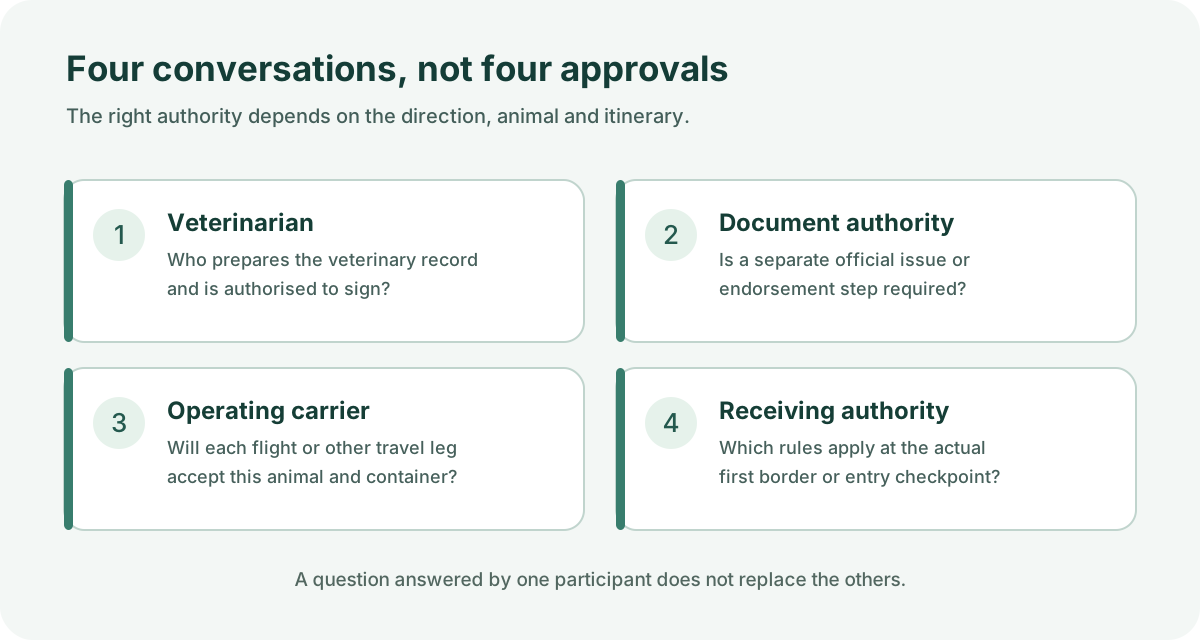
Illustration: four separate conversations. This is a planning framework, not a universal sequence or official clearance process.
1. The veterinarian: what needs to be examined or documented?
For pets departing the United States, USDA APHIS tells travellers to contact a USDA-accredited veterinarian early. Its pet-travel guidance explains that the veterinarian can help identify destination-country requirements and assist with any needed documents and USDA-endorsed certificates. [1]
This does not mean every veterinarian everywhere performs the same regulatory function. A country’s ordinary veterinary practitioner, official veterinarian and accredited veterinarian may have different roles. If your trip includes an animal health certificate, ask which kind of practitioner is authorised to complete the specific document for your route.
Questions to bring to the appointment:
- Which official entry page covers my departure country, destination, animal species and purpose of travel?
- What information must be recorded by the veterinarian, and who is authorised to sign or issue the document?
- Does this particular route require an additional government endorsement or other authority action?
- Who should answer questions about the animal’s welfare and travel fitness? (Your veterinarian—not PetWaymark.)
- Will the return journey call for a different process?
Do not confuse a veterinary appointment with final clearance. A medical or documentary step may be necessary while the carrier or border authority still has separate requirements.
2. The document authority: who issues, endorses or checks the certificate?
A completed veterinary form is not necessarily the final document for every international route. In the USDA APHIS export context, the accredited veterinarian’s preparation and any required USDA endorsement are distinguishable steps. [1]
In other places, a named competent authority or official veterinarian may carry out the relevant function. The title and document type can change with the route. Great Britain’s government guidance is a good example of why a single universal “pet passport” template cannot replace country-specific official instructions. [2]
A sensible question is not “Is this paperwork approved by PetWaymark?” but:
“For this specific route and movement category, who has the authority to issue or endorse the document, and how should I confirm that the correct version is being used?”
Document vocabulary to recognise:
| Term | Meaning in this guide | What to verify |
|---|---|---|
| Veterinary record | Evidence recorded or provided by a veterinarian | Whether the destination needs this specific record and format |
| Health certificate | A route-dependent document concerning an animal’s health or movements | Issuer, version, authorised signature and any endorsement requirement |
| Endorsement | A separate authority action where the relevant procedure requires it | Whether it is needed; who performs it; which event the official source refers to |
| Pet passport | A term used in particular legal systems and movement categories | Whether this exact passport is accepted for this journey; never assume worldwide validity |
| Receipt or confirmation | Evidence that a particular submission was made | What it actually proves, and what it does not prove about entry |
The table is an explanation of questions, not a substitute for country rules. A term used by one authority should not be treated as an identical legal document in another jurisdiction.
3. The operating carrier: can this animal travel on these actual services?
The carrier’s decision is separate from government entry documentation. IATA’s public pet-travel guidance recommends contacting the chosen airline to confirm that it accepts the pet on the intended flight. It also discusses the difference between cabin and other transport arrangements and the need for a suitable container. [3]
Ask the operating airline, not just a booking site:
- Does each flight leg accept a cat or dog of this type, in the intended carriage arrangement?
- Is the proposed carrier or crate suitable under the airline’s own requirements?
- Who checks the animal and documents at the departure location?
- What happens during a connection or a change of operating airline?
- Is an additional health certificate or transport record required by the carrier?
- How is collection arranged on arrival, if the animal does not travel in the passenger cabin?
Crate dimensions are not approval. Even when an approximate container measurement can be calculated from IATA’s published guidance, it does not establish cabin eligibility, a particular flight’s policy or animal fitness. [3]
4. The first-entry or receiving authority: what is actually inspected?
The arrival authority applies the rules of the relevant destination or first entry point. A trip marketed as “to France,” for example, may involve a connection before France. Whether a connection changes the formal entry point is a question for the actual itinerary and relevant authorities—not something a general country-pair article can decide automatically.
Consider four distinct travel facts before you ask for a final answer:
- The route: departure place, actual connecting points and final destination.
- The animal: cat or dog, and whether the described movement category really fits.
- The documents: which exact papers are required, who issued them and who must inspect them.
- The operator: which company is responsible for each transport segment.
If the official sources appear to use different wording, preserve that uncertainty. Record the source links and ask the competent authority for your actual first entry and travel arrangements rather than selecting whichever rule looks easier.
5. The journey home is not the outward journey reversed
A common planning mistake is to finish the outward paperwork and assume the same paperwork will work in reverse. That inference is unsafe: a returning animal is being imported into a different jurisdiction, potentially under different documentary and species-specific rules.
For example, USDA APHIS identifies the CDC as the primary federal authority for dogs entering or returning to the United States, and points travellers to CDC’s import rules. [1][4] That does not, on its own, answer every state, airline, cat or foreign-export question.
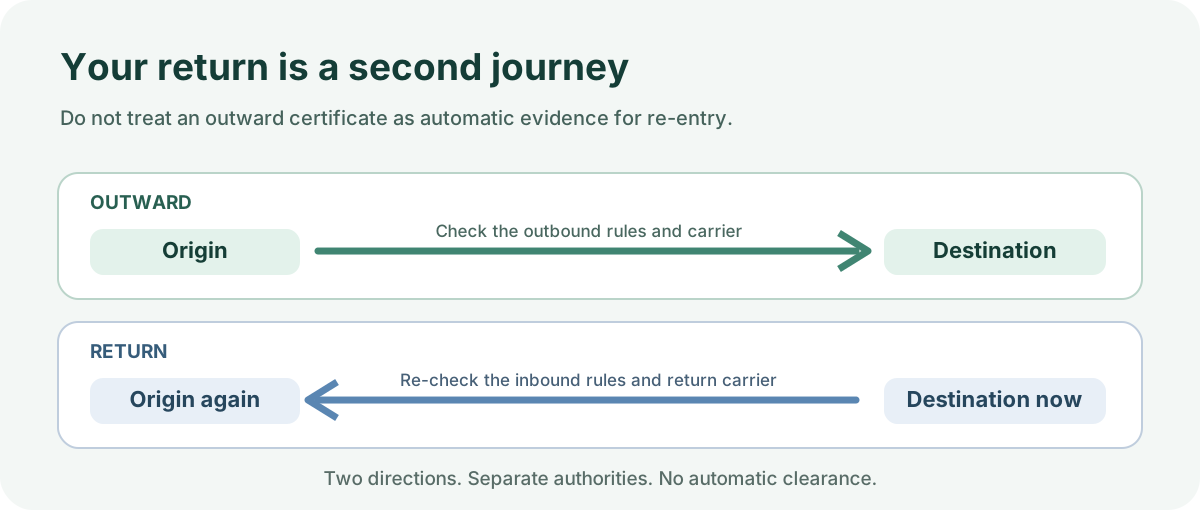
Illustration: your return is a second set of official questions, not an automatic reverse approval.
Before departure, record answers to these three return questions:
- Returning to which country? Open that country’s current inbound instructions for your species.
- Departing the foreign country under which procedure? Check who issues any outbound documents.
- Which carrier and route will be used home? Treat operating-airline and transit questions as new checks.
PetWaymark already provides separate outward and reverse-direction document handoff explainers for its limited published coverage. Those explainers are not full legal checklists.
6. A simple conversation record
Use a small working table instead of relying on memory. Do not upload private medical records or identity documents to this site.
| Conversation | My question | Official page / answer to record on paper |
|---|---|---|
| Veterinarian | Who is authorised to prepare the relevant veterinary paperwork? | __________________________ |
| Government document authority | Is a separate official issue or endorsement step required? | __________________________ |
| Carrier and connection | Who confirms the actual animal transport arrangement on every leg? | __________________________ |
| First-entry / return authority | Which receiving rules apply to this exact entry and later return? | __________________________ |
Make the next action concrete: choose an existing PetWaymark route explainer, then use Preparation Studio to organise questions and print follow-up notes. The studio records a discussion, not the animal’s clearance or the legal sufficiency of a document.
If you remember only five things
- A veterinarian, a document authority, a carrier and an entry authority are not interchangeable.
- The same term—for example “certificate”—does not guarantee the same procedure between countries.
- A carrier saying “yes” does not mean a border authority has approved admission; the reverse is also true.
- Connecting points and the journey home deserve separate questions.
- If the official pages do not clearly resolve a situation, do not convert that ambiguity into a precise date or an eligibility verdict.
Primary sources and evidence limits
[1] USDA APHIS, Travel With a Pet. https://www.aphis.usda.gov/pet-travel — directly reviewed 16 October 2026; the source explains accredited veterinarians, exporting pets and CDC’s separate US dog-import role.
[2] GOV.UK, Bring Your Pet to Great Britain. https://www.gov.uk/bring-pet-to-great-britain — directly reviewed 16 October 2026; used as an example of a jurisdiction-specific entry process, not as a rule for other destinations or a definitive summary of GB’s current document types.
[3] IATA, Traveler’s Pet Corner. https://www.iata.org/en/programs/cargo/live-animals/pets/ — directly reviewed 16 October 2026; used for airline confirmation, container and transport-role distinctions. PetWaymark is not IATA-accredited or able to certify a carrier.
[4] CDC, Bringing a Dog into the U.S. https://www.cdc.gov/importation/dogs/index.html — directly reviewed 16 October 2026; used to identify the CDC’s inbound dog-import responsibility, not to determine any individual dog’s route category or eligibility.
Source-method note: prepared with AI assistance and checked against the linked official pages on 16 October 2026. Educational questions only. No individual veterinary, airline or border approval is implied. Source review dates are not official amendment dates.