Pet travel connections: transit airports are not always the same as first entry
A connecting flight is a transport event. Formal entry is a border event. A pet can encounter both during the same journey, but they do not necessarily happen at the same place or under the same rules.
Imagine planning to travel with a dog from the United States to France on a two-leg ticket. The airline booking names Paris as the final destination and another European airport as the connection. Where should the dog’s paperwork be checked? Who moves the carrier between aircraft? Does the connection count as entry into the European Union? Do not answer any of these from the airport codes alone.
The safest starting method is to separate the questions by responsible authority and by physical journey leg. Official EU guidance identifies designated travellers’ points of entry and competent-authority document and identity checks for non-commercial movements; IATA asks travellers to identify stopovers and confirm individual airline arrangements. [1][2] Neither source makes every international transfer identical.
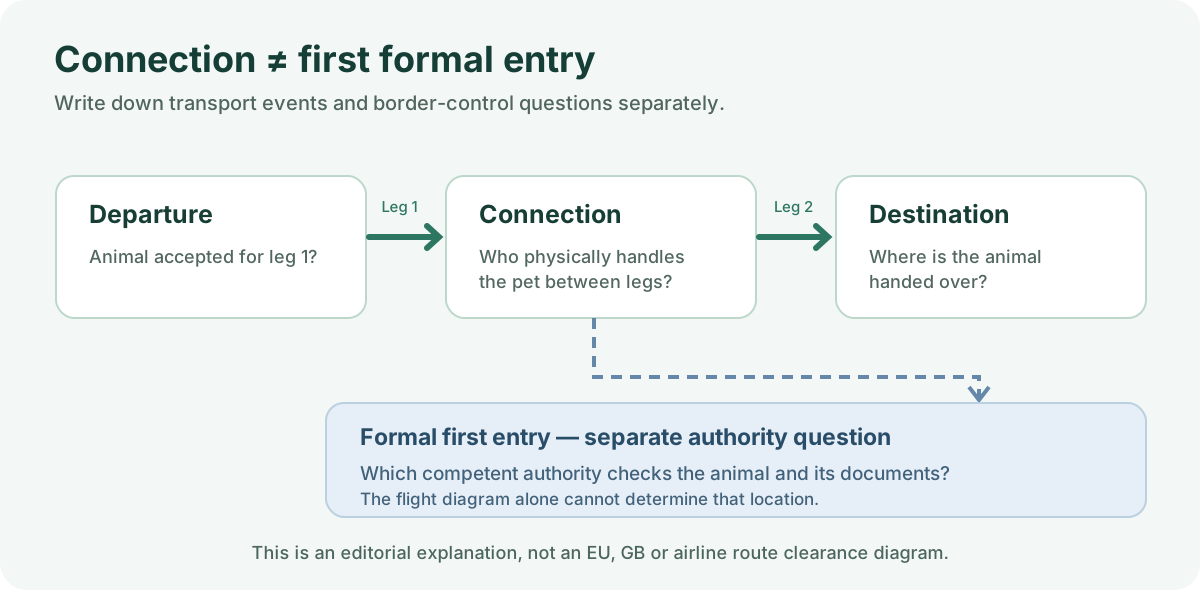
Conceptual map only. A connection does not, by itself, establish the legally applicable inspection location.
Three different events people often call “transit”
| Event | The question it creates | Who is best placed to answer |
|---|---|---|
| Flight connection | Is the animal accepted on the next operating service? Who transfers or receives the carrier? | Operating airline and its ground/air-freight handler |
| Border / first entry | Which country’s animal-entry requirements and designated inspection process apply? | Competent veterinary/border authority for the actual entry arrangement |
| Stopover or collection | Does someone collect, move, recheck or newly import the animal between legs? | Operating carrier, airport handling facility and the relevant authorities |
Those three rows can occur together, in a different order, or not at all on a particular itinerary. A passenger remaining airside is not a complete answer about an animal moved through cargo or freight facilities. Equally, changing aircraft is not proof that the animal has been admitted into the country of the connection.
Start with your actual journey, not a country pair
Before asking anyone for a verdict, write down:
- Departure: country and airport/terminal from which the animal leaves.
- First operating service: the company and the confirmed travel arrangement for the animal.
- Connection: country, airport and, if known, whether the pet remains within the airline’s custody or must be collected.
- Next service: the actual operator—not just the ticket-selling carrier.
- Final destination: where and how the animal will be delivered or collected.
- Potential return: a distinct direction with distinct transit and receiving questions.
This is an information-gathering structure, not a request to enter personal, microchip or medical information into a PetWaymark form.
Example A: a connecting flight where the animal is handled throughout
The question to the airline is: Which operator and facility are responsible for the pet during the transfer, and have both legs accepted the arrangement?
A through-ticket for a human passenger does not, by itself, answer which company handles the animal or whether either operator accepts the pet on the chosen service. IATA tells travellers to confirm their selected airline’s acceptance and to consider any stopover. [2]
The government question remains separate: For my exact animal movement and connection arrangements, where does the formal veterinary/identity entry check occur? Do not convert an airline transfer confirmation into evidence that an EU or GB border has been cleared.
Example B: the animal must be collected and presented again
If a company tells you that the carrier or animal must be collected and re-presented during the connection, record where, by whom, and under which entry and handling procedure. A cargo facility’s hours may matter to the practical journey; IATA advises travellers shipping as air freight to check that a facility will be open for collection. [2]
Ask the receiving country’s authority whether collection or onward carriage changes the animal’s formal entry treatment. PetWaymark cannot classify the legal status of a particular “airside,” “landside” or customs movement.
Example C: a journey planned as “France” that reaches another EU location first
EU’s official Your Europe page explains that eligible non-commercial pets entering from outside the EU may need to pass through a designated travellers’ point of entry, where competent authorities inspect documents and identity. [1]
The correct first-entry conclusion depends on the real route and legal movement category. If the flight stops elsewhere in the EU, ask whether that location is the pet’s actual first official entry and what document language/inspection instructions apply there. The site should not infer first entry automatically from the first scheduled landing or from the final flight shown in a booking confirmation.
Example D: the final destination is Great Britain
Great Britain is not interchangeable with the EU for pet-entry planning. England, Scotland and Wales have their own government route and transport rules. GOV.UK says only certain routes and companies may be used to enter Great Britain with pets, and its approved-routes page changes over time. [3] For normal commercial air entry, GOV.UK’s general rule calls for pets to travel as cargo, with stated exceptions such as qualifying assistance dogs and chartered private flights. [3]
This matters even when a pet travels in a cabin on some earlier leg. An operator accepting a cabin arrangement elsewhere does not override the GB arrival rule. Northern Ireland has separate guidance and is not covered by PetWaymark’s GB direction label.
A conversation script for each authority
To the operating carrier:
- Has my animal been accepted on each named service, not just on the booking?
- Is the movement in the cabin, on a baggage arrangement, or managed as air freight?
- Who retains responsibility during the connection, and where will the animal be checked or released?
- Does the carrier need any additional records beyond the receiving government’s requirements?
- What changes if the second flight is cancelled or substituted?
To the border/veterinary authority:
- Which competent authority determines the animal’s first formal entry point for this itinerary?
- Does the animal have to use a designated pet-traveller inspection point?
- What documentary format and inspection process are appropriate to that first entry?
- Does any connection, collection, overnight stay or change of custodian alter the classification?
- Do the outward and homebound directions need separate entry paperwork?
To the veterinarian or certificate-issuing office:
- Does the document being prepared refer to the correct receiving authority and movement category?
- Are any language, origin, endorsement or route details relevant?
- Who must answer an unresolved first-entry or transfer question before a document is issued?
The answer “the airline allows pets” belongs to the first conversation, not the second or third.
Five warning signs of an oversimplified travel checklist
“The destination airport is all you need.” This omits operating-carrier transfers and may miss the real formal entry arrangement.
“Transit never counts as entry.” Neither a connection nor its airside label establishes the entire animal movement’s legal classification. Ask the responsible border authority.
“The pet is approved because a kennel reservation exists.” A space reservation is not a veterinary document and does not bind the importing authority.
“Every EU airport accepts every pet movement.” The EU has designated entry procedures; use the current, relevant official pages. [1]
“The same booking works in reverse.” Homeward travel is a different import/export direction, often through different authorities. Record new operators and checks.
Your practical four-line handoff worksheet
| Stage | Contact / reference number | Confirmed answer or unresolved question |
|---|---|---|
| First operator + animal arrangement | __________ | __________ |
| Connection handler / second operator | __________ | __________ |
| First formal receiving authority | __________ | __________ |
| Return route and authority | __________ | __________ |
Write only the information needed for your own conversation record. Never treat the worksheet as a travel-permission document. For the countries currently supported by PetWaymark, consult its direction-specific official-source-linked guides and open Preparation Studio to keep the questions organised. The studio cannot certify your journey.
Primary references and review limits
[1] European Commission, Your Europe: Travelling with pets and other animals in the EU. https://europa.eu/youreurope/citizens/travel/carry/pets-and-other-animals/index_en.htm — read 16 October 2026. Used for the non-commercial scope, designated points of entry and competent-authority checks. The page’s general guidance is not a ruling on the reader’s particular connection.
[2] IATA, Traveler’s Pet Corner. https://www.iata.org/en/programs/cargo/live-animals/pets/ — read 16 October 2026. Used for operating-airline arrangements, journey breaks and air-freight facility enquiries, not as a source for a legal definition of “airside transit.”
[3] GOV.UK, Bringing your pet to Great Britain: Travel routes for pets. https://www.gov.uk/bring-pet-to-great-britain/travel-routes-pets — read 16 October 2026. Used only for entering Great Britain, its approved-route/transport process and its stated airline exceptions. Approved lists and individual service policies can change.
Source-method note: prepared with AI assistance and checked against the linked official pages on 16 October 2026. Educational questions only. No individual veterinary, airline or border approval is implied. Source review dates are not official amendment dates.