Cabin, hold or cargo? Questions to settle before booking pet air travel
Your first question may be, “Can my cat fly with me?” or “Will my dog go in cargo?” Those sound like questions about one airline rule. In practice, they refer to several separate decisions: the service offered by the operating airline, the animal’s permitted arrangement on that flight, the container, the documents and the people who will handle the animal during a connection.
This guide explains useful distinctions and gives you a non-medical, non-legal question list. It will not tell you that a particular animal is accepted, that a specific carrier is certified, or which flight you must book.
Start with three distinct arrangements
| Description a traveller might hear | What to ask rather than assume |
|---|---|
| In the passenger cabin | Does the actual operating airline accept your cat or dog in the cabin on every booked leg? What kind of container, placement and advance arrangement does that airline require? |
| In the aircraft hold as part of passenger baggage arrangements | Does this airline offer a pet-acceptance service under that name? Who receives the animal, checks the kennel and returns the animal at the other end? |
| As air freight or manifest cargo | Which animal-shipping arrangement, facility and receiving process will handle the animal? What must the sender and recipient provide, and which company is responsible at connections? |
These descriptions are not universal legal classifications and an airline may use different terms. “Hold” identifies a part of an aircraft; it does not on its own explain the booking contract, who accepts the animal, or the documents required. In its public guidance, IATA distinguishes cabin travel, animal transport in the hold and shipment as air freight, and tells travellers to confirm arrangements with the chosen airline. [1]
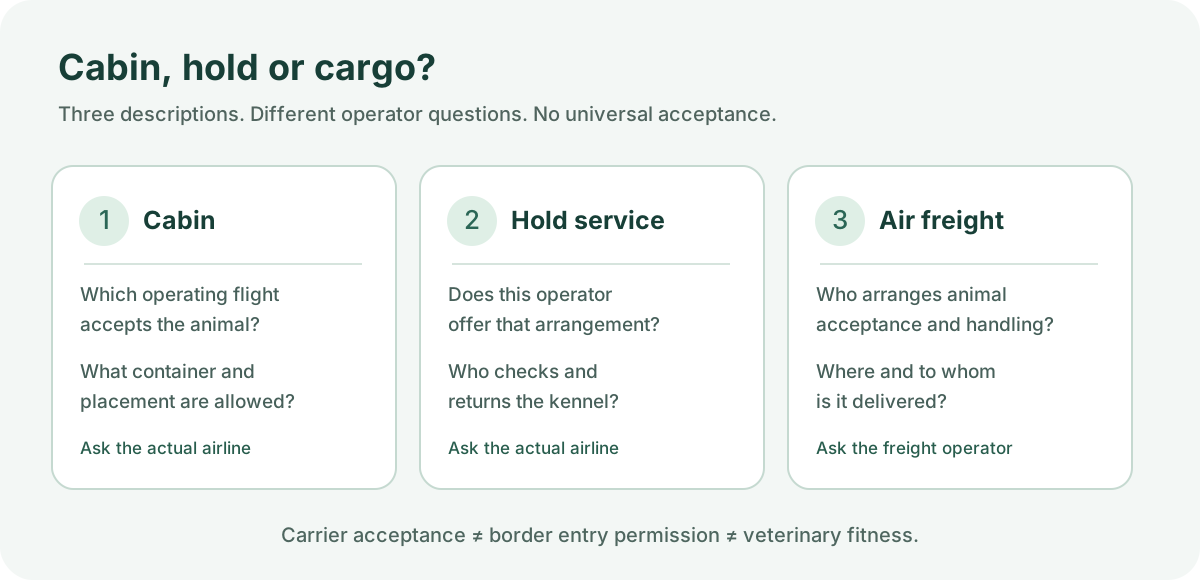
Illustration: different arrangements mean different questions to the operating carrier. It is not a table of airline weight limits.
Why “the flight allows pets” is not enough
Imagine a journey with two flights booked through the same travel portal. The first leg is run by Airline A and the second by Airline B. The booking page may display only one itinerary, while pet acceptance can depend on the operating service and the arrangements at the connection.
Before paying for travel, record exactly whom you have asked and which flights the answer covers. IATA specifically advises travellers to contact the selected airline to confirm that the pet is accepted on the intended date and flight; airlines can restrict the number of animals on a service. [1]
Write down:
- Which company operates each flight, even if another company sells the ticket?
- Is a pet accepted on that specific date and service?
- Is the arrangement in-cabin, a hold-related passenger service, or air freight?
- Is the animal transferred by the operators during the connection, or must another party collect and re-present it?
- Who will inspect the carrier and any supporting documents at the transfer?
- At what facility will the animal be handed over or collected?
- If plans change, who should confirm a pet’s new service rather than assuming the human ticket automatically covers it?
If you do not know the answers, the correct result is “ask the actual carrier”, not “travel ready.”
The container is a separate question
IATA’s public Traveler’s Pet Corner describes the need for a suitable, appropriately sized container. It publishes a general formula for approximate internal container dimensions and identifies animal measurements. These are about container space, not an airline’s in-cabin allowance or veterinary fitness assessment. [1]
USDA APHIS provides a detailed training lesson for transporting cats and dogs by air, including container size, construction, cleanliness, ventilation, secure fastening and labelling. [2] That training addresses its stated regulatory context; it is not a substitute for the selected operator’s current rules, an international standard certification or a custom assessment of your animal.
Questions for your operator and veterinarian:
- What are the container’s permitted external dimensions for this service?
- What internal space, materials and ventilation does the operator expect?
- May this exact bag or kennel travel in the proposed arrangement?
- How are doors, handles, padding, labels and identification checked?
- Are there additional requirements for this species, animal, itinerary or operating company?
- Who can advise on the animal’s fitness and welfare during transport? The veterinarian, not a website calculator.
Avoid the word “IATA approved carrier” unless you can actually point to an authoritative certification scheme and certified product. PetWaymark’s future measurement worksheet will be an educational tool, not an airline approval service.
Separate transport permission from border paperwork
An airline accepting an animal on a particular service and a country permitting the animal to enter are different questions. Government-issued or government-endorsed paperwork, vaccination records and other destination requirements, if applicable, are governed by the relevant authorities.
For US exports, USDA APHIS advises travellers to work with a USDA-accredited veterinarian on the destination country’s pet-travel requirements. [3] For a dog entering or returning to the United States, CDC is a separate federal authority. [4]
This guide does not extrapolate those US roles to every nationality, nor does it interpret the documentary or health rules for a particular passenger. You must read the current official direction-specific material rather than using generic flight rules as a border-entry checklist.
Five cases that deserve an extra call
A cat or dog on a connection
Which company will physically handle the animal between legs, and which country’s controls might become relevant if the itinerary changes? Do not assume that remaining in the airport means the animal is automatically exempt from every local procedure.
An airline offers one arrangement outbound and another on return
The reverse service may operate under a different carrier or product. Ask anew. A confirmed outward booking does not cover the return.
A travel agent says a kennel is suitable
Confirm with the operator actually transporting the animal. A retail description or sizing formula is not a carrier acceptance letter.
The animal’s health or stress is a concern
Ask a qualified veterinarian for professional guidance. PetWaymark does not recommend sedatives, fasting periods, water restriction, temperature cutoffs or any diagnosis. USDA APHIS training discusses health considerations, but that is not a personal veterinary assessment. [2]
A pet appears to meet the airline’s transport conditions
That still does not prove that the border authority will accept the animal. Return to your official, direction-specific document guide and verify the entry rules independently.
Keep a written confirmation sheet
| Who to ask | Question | Answer / official record |
|---|---|---|
| Operating carrier for leg 1 | Exactly which pet arrangement is available for this leg? | _________________________ |
| Operating carrier for leg 2 | Does this service allow the same animal and container? | _________________________ |
| Transfer handler or operator | Who handles the animal at the connection and where is it collected? | _________________________ |
| Veterinarian | Which health or welfare considerations need professional assessment? | _________________________ |
| Document authority / entry point | Which current documents or inspections apply to the trip? | _________________________ |
Save the information with your own travel notes and revisit it before your booking changes. For a separate, printable organisation space, open PetWaymark Preparation Studio and use the official-source-linked questions. It does not provide a travel clearance decision.
What this article does not contain
No universal carrier weight limits, no airline ranking, no price estimate, no breed-based flight decision, no time-window calculator, no sedative or feeding schedule, no cargo safety guarantee, and no claim that these three headings represent every operator’s exact product names.
The practical outcome should be a specific list of questions for named companies and authorities, not a green “ready to fly” indicator.
Primary sources and boundaries
[1] IATA Traveler’s Pet Corner — https://www.iata.org/en/programs/cargo/live-animals/pets/ — reviewed 16 October 2026. Basis for cabin/hold/air freight distinctions, suitable container and airline confirmation. IATA guidance is not individual airline approval.
[2] USDA APHIS, Pets on Planes Lesson 1 — https://www.aphis.usda.gov/pet-travel/pets-on-planes/preparing-pets-air-travel — reviewed 16 October 2026. Basis for the categories of kennel quality, welfare and handling questions. Its U.S. framing is not a worldwide regulation.
[3] USDA APHIS, Travel With a Pet — https://www.aphis.usda.gov/pet-travel — reviewed 16 October 2026. Export-veterinarian and document-authority background, not an itinerary-specific certificate decision.
[4] CDC, Bringing a Dog into the U.S. — https://www.cdc.gov/importation/dogs/index.html — reviewed 16 October 2026. Identifies the separate dog-import authority, not the reader’s personal route eligibility.
Source-method note: prepared with AI assistance and checked against the linked official pages on 16 October 2026. Educational questions only. No individual veterinary, airline or border approval is implied. Source review dates are not official amendment dates.