Bringing your pet home: the return is not your outward trip in reverse
The country you leave, the country you re-enter, the carrier and the applicable document authorities can all change on the way home. “My pet already travelled there” is not a substitute for checking the inbound rules.
A traveller might keep a folder of certificates, a confirmed outbound booking and a photograph of the pet’s carrier, then assume those items guarantee a smooth trip home. The problem is not the folder. The problem is the assumption that the same evidence has the same legal purpose in both directions.
PetWaymark’s central rule for a return journey is simple: research the return as a second one-way movement. Ask who is responsible for export from the location you visited, import to the home country, the actual transport arrangements and any intermediate checks. This framework applies even if the owner and animal are the same on both flights.
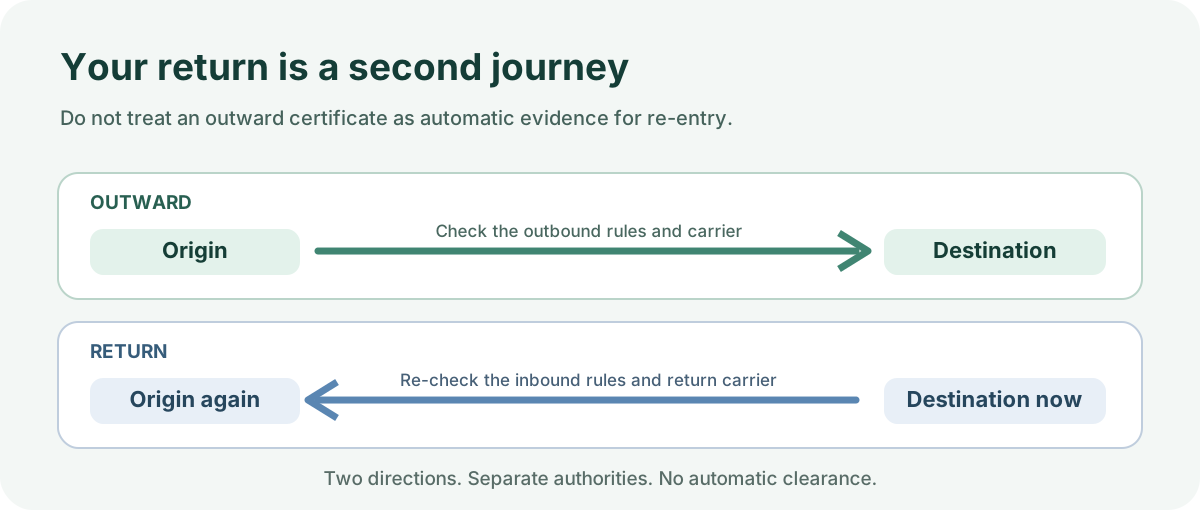
The arrows describe questions in opposite directions, not guaranteed border acceptance.
A return itinerary changes the receiving authority
Consider two abstract journeys: Country A → Country B, followed by Country B → Country A. On the outward leg, Country B is receiving the animal. On the homeward leg, Country A is now receiving the animal, while Country B may have separate requirements for departure or documentation.
| Question | Outward journey | Homeward journey |
|---|---|---|
| What is my departure territory? | A | B |
| Who regulates the animal’s arrival? | B’s relevant authorities | A’s relevant authorities |
| Who issues or endorses the outbound paperwork? | Appropriate office for the A→B procedure | Appropriate office for the B→A procedure |
| Which operator accepts the animal? | Outward services | Actual return services |
| What if I connect? | Outward first-entry and handling questions | New first-entry and handling questions |
| What proves readiness? | No generic site can certify this | No generic site can certify this |
Do not use this table as a legal rule for a particular country. It tells you which separate official questions exist.
Example 1: returning to the United States with a dog
USDA APHIS states clearly that CDC is the primary federal authority for dogs entering or returning to the United States. APHIS has its own responsibilities for certain animal-health conditions, and state or territory requirements may also apply. [1][2] The CDC has a dedicated dog-import site that explains how the relevant requirements depend on the dog’s history and other circumstances. [3]
The important planning consequence is before departure: a dog that is later returning to the US may need an authorised process arranged while still in the US, depending on its travel circumstances. USDA’s official US export page expressly warns travellers planning to return with dogs to check both APHIS and CDC guidance before leaving. [4]
This article does not determine whether an individual dog is in a low-risk or high-risk rabies pathway, whether its vaccination history meets a CDC rule, or whether a particular receipt is sufficient. Those are route- and animal-specific decisions for the current official CDC process.
Ask these instead:
- Which current CDC dog-import pages apply to the exact countries visited and the animal’s history?
- Is any document required to be completed before leaving the United States, even though the dog is returning later?
- Does USDA APHIS Veterinary Services have an applicable import concern for the country from which the dog is returning?
- Which destination state or territory has additional animal-entry instructions?
- Has the actual operating carrier accepted this animal for the return services?
The existence of an American owner, US-origin vaccination record or previous admission does not answer these five questions.
Example 2: returning to the United States with a cat
Do not copy a dog-specific CDC checklist onto a cat. APHIS’s dedicated page for domestic pet cats entering the US says its Veterinary Services branch has no animal-health import requirements for that particular cat-import category, but directs readers to other federal authorities and to state or territorial rules. [5] “No APHIS Veterinary Services animal-health requirements” is a narrow statement about one agency, not proof that cats need no documents, examinations or carrier acceptance.
Ask the responsible authorities and carrier which conditions apply to the particular cat’s route, rather than treating dog forms as universal or assuming no checks exist.
Example 3: returning to Great Britain
GOV.UK treats arrival or return to Great Britain—England, Wales and Scotland—as a distinct set of animal-entry procedures. Its official pages differentiate travel-document categories by where the animal is coming from and explain the checks on arrival. [6][7]
The right document for return depends on the described route and legal category; a document useful on the outbound journey may not cover every new trip. GOV.UK’s animal health certificate (AHC) page discusses certain GB-issued certificates that can be used for specified returns from eligible places under its conditions, but this is not a universal pet-passport extension and not a promise for your animal. [8]
There is also a transportation question. GOV.UK requires approved routes and relevant operators to bring pets to GB except for specified cases; travellers should confirm the current route and the carrier’s own pet arrangements. [9] Even where a veterinary document could be accepted, an inappropriate or unavailable route can prevent the intended journey.
Northern Ireland is not included in this Great Britain example; it has separate official movement instructions.
Example 4: going back to an EU country
The EU’s official Your Europe guidance explains the difference between a European pet passport used within the applicable EU framework and an EU animal health certificate used for qualifying movements from outside the EU. It describes veterinary/identity checks at designated entry points and some conditional procedures on re-entry. [10]
This does not mean every EU resident returning from every third country uses the same document. A return plan should ask:
- Does the animal already hold an accepted, properly maintained document for this movement, or must another document be issued?
- Which official page discusses the specific departure country and return category?
- Is there a designated first-entry check and where will that check occur on the actual itinerary?
- Do the animal’s records require review by a qualified veterinarian before travel?
- Does a connecting carrier or a stopover create a separate question?
Do not infer vaccine, antibody-test, certificate or travel dates from generic figures printed in another route guide. Ask the issuing and receiving authorities to decide which clock applies to your individual case.
A homebound “who do I ask?” map
- The foreign authority or issuing veterinarian: What, if anything, must be prepared or verified before leaving the country visited?
- The home country’s importing authority: What does the actual inbound category require, and which evidence proves it?
- The actual operating carrier: How will the pet travel on every leg, and which documents does the carrier itself require?
- The first-entry or connection authority: Where does the relevant formal inspection happen, including collection and custody transfers?
- The local receiving authority: Are any state, provincial or subnational rules relevant beyond national requirements?
Not every role will issue a separate document. You are identifying responsibility, not collecting paper for its own sake.
Mistakes this independent return check prevents
Reusing the outbound certificate as the return checklist. Its issuer and function may differ in the other direction.
Treating a carrier booking as government import clearance. Operators and governments have different jobs.
Ignoring the animal’s travel history. When an official programme depends on where a pet has been, “I live here” does not replace the programme’s own question.
Forgetting the departure side of the return. Re-entry documentation is not the only process; a local official or veterinarian abroad may also have a role.
Treating Great Britain and Northern Ireland as one rule set. Official movement pages explicitly distinguish them. [6]
Assuming a passport is globally valid because it is called a passport. The issuing jurisdiction, movement category and up-to-date veterinary record matter. [10]
Build a two-direction conversation record
| Write this before the trip | Outward | Return |
|---|---|---|
| Origin and actual destination | ______ → ______ | ______ → ______ |
| Official entry source | __________ | __________ |
| Correct document or issuing-office question | __________ | __________ |
| Operating carrier for every leg | __________ | __________ |
| Connection / formal first-entry query | __________ | __________ |
| Outstanding uncertainty and who will answer | __________ | __________ |
Use the PetWaymark Preparation Studio for the currently published country-pair administrative questions; it does not establish eligibility and does not hold medical records. If you cannot find a guide for your actual direction, use the official authorities directly rather than substituting a nearby route.
Source register and limits of what was checked
[1] USDA APHIS, Travel With a Pet — https://www.aphis.usda.gov/pet-travel — checked 16 October 2026. Distinguishes APHIS export help and CDC inbound dog regulation.
[2] USDA APHIS, FAQ: Importing Pet Dogs Into the US — https://www.aphis.usda.gov/pet-travel/another-country-to-us-import/dogs/frequently-asked-questions — checked 16 October 2026. Confirms that returning dogs can face federal and state checks; no pathway is assigned here.
[3] CDC, Bringing a Dog into the U.S. — https://www.cdc.gov/importation/dogs/index.html — official dog-specific import programme reference; not a determination of any dog category.
[4] USDA APHIS, Take a Pet From the US to Another Country — https://www.aphis.usda.gov/pet-travel/us-to-another-country-export — checked 16 October 2026. Makes the pre-departure CDC/APHIS return-planning distinction.
[5] USDA APHIS, Bring a Pet Cat Into the US — https://www.aphis.usda.gov/pet-travel/another-country-to-us-import/cats — checked 16 October 2026. Limited to APHIS Veterinary Services and points to other authorities.
[6] GOV.UK, Bring Your Pet to Great Britain — https://www.gov.uk/bring-pet-to-great-britain — checked 16 October 2026; GB-only scope.
[7] GOV.UK, Arriving in Great Britain — https://www.gov.uk/bring-pet-to-great-britain/coming-back-to-great-britain — checked 16 October 2026; arrival checks.
[8] GOV.UK, Animal Health Certificate (AHC) — https://www.gov.uk/bring-pet-to-great-britain/animal-health-certificate-ahc — checked 16 October 2026; limited to conditional applicability described by GOV.UK.
[9] GOV.UK, Pet Travel Routes — https://www.gov.uk/bring-pet-to-great-britain/travel-routes-pets — checked 16 October 2026; service/route changes possible.
[10] European Commission, Your Europe, Travelling with pets and other animals in the EU — https://europa.eu/youreurope/citizens/travel/carry/pets-and-other-animals/index_en.htm — checked 16 October 2026; general non-commercial EU guidance and document distinctions.
Source-method note: prepared with AI assistance and checked against the linked official pages on 16 October 2026. Educational questions only. No individual veterinary, airline or border approval is implied. Source review dates are not official amendment dates.