Preparing an air travel carrier: what to measure, inspect and ask
A suitable animal carrier is not simply the one with the right product label. It must also work for the animal, the proposed journey and the operator who will handle it.
If you are buying or reusing a container for a cat or dog travelling by air, it is tempting to search “IATA-approved cage” and choose the first product described as compatible. That wording is misleading unless the seller can substantiate an actual, relevant approval. PetWaymark does not approve containers and cannot check a carrier’s fit for your animal.
IATA publishes transport-related guidance about an animal’s ability to stand, turn and lie naturally in a suitable container, a method for approximating its internal dimensions, and warnings that the selected airline must accept the animal and arrangement. [1] USDA APHIS provides detailed air-transport lessons about container construction, ventilation, security, handling, labelling and welfare in its described US regulatory context. [2]
This guide turns those sources into a measurement explanation and a five-part discussion record. It is not a substitute for the operating carrier’s specifications or your veterinarian’s animal welfare assessment.
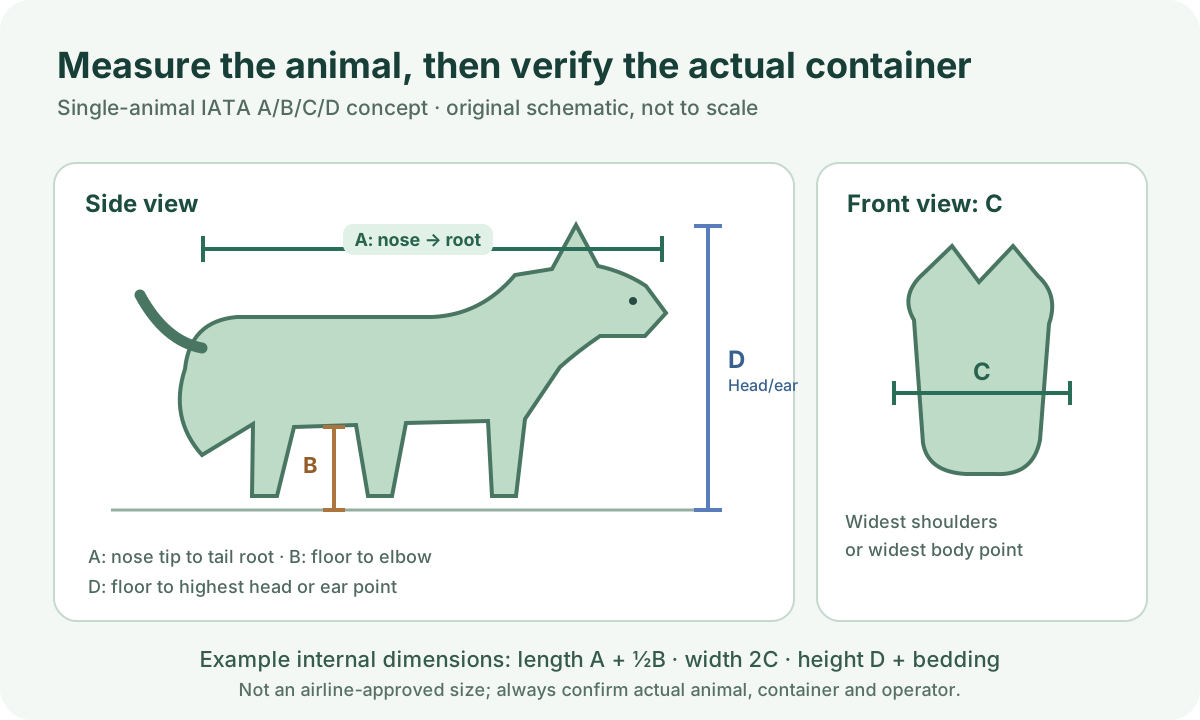
Original conceptual diagram, not an official IATA drawing. Read IATA’s actual measurement graphic before measuring an animal.
1. Understand the four measurements before touching a calculator
IATA explains the measurements this way for approximate container sizing. [1]
| Label | What the traveller measures | Common interpretation error |
|---|---|---|
| A | Length from the tip of the nose to the base/root of the tail | Using the end of the tail, or confusing with external kennel length |
| B | Vertical height from floor to the animal’s elbow joint | Substituting the animal’s full leg height |
| C | Width across shoulders or the widest point, whichever is greater | Measuring a harness rather than the animal |
| D | Height from floor to the top of the head or the ear tips, whichever is higher in the natural standing position | Measuring to a lowered or crouched head |
| Bedding | The thickness added when calculating the internal height | Assuming the bedding thickness is already included in D |
For a single animal, IATA’s general illustration gives approximate internal container dimensions:
- Internal length = A + one half of B.
- Internal width = two times C.
- Internal height = D + bedding thickness.
IATA explicitly identifies additional considerations, including a larger container for snub-nosed breeds and separate arrangements for multiple animals. Those are not silently resolved by PetWaymark’s simplified single-animal arithmetic. Read IATA’s original 2026 CR1 material and ask a carrier or professional to assess the actual animal. [1]
A number is not acceptance. The formulas do not establish that a container meets an airline’s external size limits or its particular flight service; they are not a medical assessment or a certificate.
2. Measure internal space—not the retail box dimensions
If the manufacturer gives a measurement for the outside of a plastic crate, that number includes its walls, frame or wheels. External length is not internal length.
A shopper can also encounter measurements for a soft-sided travel bag, an airline’s under-seat allowance and an air-freight rigid kennel. These may all describe “carriers,” but they answer different questions.
| Printed or calculated number | Use it to ask | Do not conclude |
|---|---|---|
| Animal measurement A/B/C/D | What approximate interior space does the published guidance illustrate? | “This airline will accept my pet.” |
| Product internal dimensions | Does the real usable space appear adequate for review? | “My pet is safe and medically fit.” |
| Product external dimensions | Does this operator’s service allow this external size or construction? | “All routes and operators use the same dimensions.” |
| Airline-specified limitation | Which arrangement and service does the operator mean? | “National border entry is approved.” |
| Seller’s “IATA-style” marketing | Can the seller identify precisely what it claims and its evidence? | “The product has an official PetWaymark or IATA certificate.” |
PetWaymark’s proposed Carrier Measurement Sheet uses the single-animal arithmetic for education. Even a perfect arithmetic result needs separate physical fit checks, construction review, carrier acceptance and, where relevant, professional veterinary input. It does not calculate a minimum legal or airline-approved size.
3. Inspect the parts of the actual container
Using the categories discussed by APHIS and IATA, prepare questions for the airline about:
Frame and closures. Will the structure, door, catches and fasteners be accepted for the selected service? Does the operator require a particular construction type or extra securing method?
Ventilation and clearance. Is the actual container’s ventilation and animal movement space suitable under the relevant carrier’s rules? Does the bedding interfere with usable internal height?
Handling points. How will ground staff lift and secure the container? Must handles, wheels, labels or attachment points be modified or removed?
Identification and labels. What identifying information or document pouch does this operating carrier require? Avoid publishing the owner’s home address, medical records or microchip number on public sites.
Cleanliness and absorbent material. What lining and preparation does the operator accept? Ask the veterinarian about animal-specific welfare questions rather than relying on a generic website.
The detail is intentionally framed as a set of checks. PetWaymark does not assess whether a particular lock, zip, door or kennel complies with an operator’s standards.
4. Cabin arrangements versus other air carriage
The word “airline carrier” can mean a soft-sided cabin bag, a rigid container under a passenger baggage arrangement or a kennel transported through an air-freight process. The company you book with may have different facilities and document questions for each. IATA asks travellers to contact the chosen airline and check whether it accepts the pet on the requested date and flight. [1]
There is an important Great Britain example of why generic airline advice is insufficient: GOV.UK says, for pets being brought into Great Britain by plane, they generally must travel as cargo, with specific exceptions. [3] That destination-specific rule cannot be replaced by an unrelated airline’s general “pets in cabin” marketing page.
Ask which actual travel product the operator is offering; do not assume the same arrangement applies when you fly back.
5. Make welfare questions explicit without taking medical advice from a website
People often ask what temperature is safe, whether an animal can travel with an existing condition, whether a dog will be calm enough, or whether sedatives are useful. These involve medical, welfare and handling circumstances that a generic client-only measurement calculator cannot diagnose or manage.
IATA’s travel page discusses factors such as animal size and suitability; APHIS provides preparation and health-related lessons for air transport. [1][2] Use them as educational reading. For your own pet, ask a qualified veterinarian about its individual welfare and fitness; do not derive a dose, fasting period, oxygen requirement or no-fly decision from this guide.
PetWaymark intentionally offers no drug, sedation, temperature threshold, animal weight cutoff or breed travel decision.
Make a repeatable carrier review sheet
Copy or print these questions before talking to an operator:
| Check | My observed facts | Who will confirm? |
|---|---|---|
| Animal measurements A/B/C/D | __________________ | Airline or qualified carrier/animal-welfare expert |
| Container’s internal usable dimensions | __________________ | Operator; assess physical fit |
| Container’s external measurements | __________________ | Each actual operating airline |
| Door, locking, ventilation and handling | __________________ | Operator/handling provider |
| Which transport arrangement is booked | __________________ | Named carrier/service |
| Connecting flight or handover | __________________ | Each operator + relevant handler |
| Animal welfare questions | __________________ | Veterinarian |
| Entry/export paperwork | __________________ | Veterinary and border authorities |
No single cell is a pass/fail gate. The record lets you ask precise questions and preserve the answers you receive elsewhere.
Common questions
Does “IATA compliant” on a product description mean IATA certified it?
Not by itself. Require precise supporting evidence for any claimed approval, and get the operator’s own acceptance criteria.
Is a carrier “airline approved” if the length formula matches?
No. The formula is illustrative internal-space arithmetic, not an external cabin limit or a carrier acceptance decision.
Can I enter my dog’s or cat’s personal medical history here?
No need. PetWaymark does not request veterinary records, names, microchip numbers or health history to generate a measurement example. The relevant fitness discussion belongs with a qualified professional.
Does the same crate work on the return?
Do not assume so. Different flights, operators, handover facilities and jurisdictions may impose different requirements. Confirm the actual return service.
Can two animals share a carrier?
Do not apply the single-animal formula or presume approval. IATA discusses separate circumstances for multiple animals, and local regulation and airline policy can be stricter. [1] Confirm separately.
Sources and editorial status
[1] IATA, Traveler’s Pet Corner. https://www.iata.org/en/programs/cargo/live-animals/pets/ — examined 16 October 2026. Primary basis for A/B/C/D, the single-animal internal dimensions, additional snub-nose/multiple-animal considerations and carrier enquiries. Its separate Container Requirements 1 (CR1, 2026) PDF is the correct source to review before any actual kennel decision. This site does not reproduce that official illustration.
[2] USDA APHIS, Pets on Planes: Preparing Pets for Air Travel. https://www.aphis.usda.gov/pet-travel/pets-on-planes/preparing-pets-air-travel — examined 16 October 2026. Used for preparation and handling/kennel inspection categories. Its US regulatory scope is not a worldwide certification scheme.
[3] GOV.UK, Bringing a Pet to Great Britain: Travel routes. https://www.gov.uk/bring-pet-to-great-britain/travel-routes-pets — examined 16 October 2026. Cited only for GB-specific carriage arrangements and stated exceptions, not as a rule for EU/Northern Ireland or everywhere else.
Source-method note: prepared with AI assistance and checked against the linked official pages on 16 October 2026. Educational questions only. No individual veterinary, airline or border approval is implied. Source review dates are not official amendment dates.